
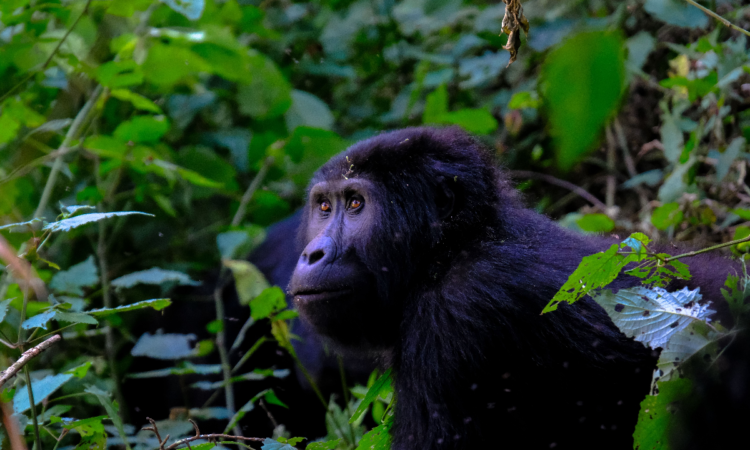
A tailor-made gorilla habituation experience in Bwindi National Park is a traveler’s dream. Many people would desire to experience what it is like to encounter a semi-habituated gorilla family in the forest. You find them after tracking them from the trailhead with a group of researchers, habituators and ranger guides. The raw wild behaviors of the gorillas are on full display right in front of you. Glimpses of the researcher’s factual survey results can also be offered to you to get firsthand knowledge and experience.
How to do gorilla habituation?
Unlike gorilla trekking tours in Bwindi National Park, habituation starts at 6:30 a.m. But, like trekking tours, gorilla habituation experiences start with briefing before you head into the jungle. The park guides will address you in a short session about the semi-habituated gorilla family you hope to see. With the researchers, guides and habituators, enter the forest and look for them. You must be 4 visitors in total. After you find the family, 4 hours is offered to see the wild gorillas interact among themselves and their surroundings. When you are done, return to the trailhead for debriefing.
Where to do Gorilla Habituation in Bwindi?
It Is only in Rushaga Gorilla Sector can you enjoy a gorilla habituation experience in Uganda. This is one of 4 sectors in Bwindi National Park. Rushaga is found in the southern region of Bwindi Impenetrable National Park. Other than it, the other 3 include Buhoma, Ruhija and Nkuringo sectors. Rushaga is an iconic sector with 10 habituated gorilla families, most of which are available for gorilla tracking tours. They are Tindatine, Rwigyi, Kahungye, Mishaya, Busingye, Mucunguzi, Bweza, Bikingi, Kutu and Nshongi etc.
Cost of Gorilla Habituation?
To get a permit to participate in a gorilla habituation experience, foreign non-residents need to have $1,500 per person. For a foreign resident or visitor from the Rest of Africa, you need to have $1,000. An East African Community citizen, including a Ugandan, you need only shillings 750,000 per person. From January 1, 2027, things will change as the Uganda Wildlife Authority has set new rates for gorilla habituation, especially for foreign visitors. Foreign nonresidents will start paying $1,800 each while foreign residents only $1,600 each.
However, you should know that in the peak season, these permits are difficult to acquire because so many people want them. Gorilla tours in Uganda are that competitive, so you need to book earlier enough, like 3 months prior. Contact us to help you with that, being a reputable tour operator whose team has done these for many years. With a Uganda Tourism Board license and strong work relation with Uganda Wildlife Authority, buying the permit on your behalf will prove smooth and free of any inconveniences. Check out the positive reviews on TripAdvisor for more proof.
How to Travel to Bwindi?
A transfer to Bwindi Impenetrable National Park is done either in a vehicle or aircraft. Use road transportation if you love scenic views and pauses for lunch and photography. But, starting from Kampala, you drive for 501 kilometers to Bwindi. This is quite long but memorable. Make the transfer much shorter using a domestic flight. From Entebbe International Airport, you board a scheduled flight to an airstrip nearby. This is either Kihihi or Kisoro airstrip, with the flight clocking in at 1 hour 15 minutes.
When to Travel for Gorilla Habituation?
Traveling for any gorilla habituation experience can be done at any day of the year, even on a public holiday. But, for the challenges involved in searching and watching the gorillas they seem to reduce during the dry season. This is when the gorilla trails are less muddy thus offer stability during movement. Rains fall less and infrequently to ensure the vegetation cover is not so dense. This makes it clearer to watch all the family members at the same time. If you prefer such simplicity, travel in the months between June to August, and December to February.
Information about Bwindi National Park
Bwindi Impenetrable National Park is a forested destination of 321 square kilometers in size in southwestern Uganda. In 1994, Bwindi became a UNESCO World Heritage site after being gazetted as a national park in 1991. This luxuriant forest is home to rare biodiversity with its flagship species being the mountain gorilla. There are 459 individuals, which make up almost a half of the total global population of mountain gorillas. They generally live in families inside the lowland and Afromontane habitats. Other habitats comprise rivers, streams, woodland and others.
Bwindi, situated at the edge of the biodiverse rich Albertine Rift region implies that it houses more species other than gorillas. For examples, there are 357 bird species, 120 mammal species and 200 tree species. Some of the mammal species comprise primate species other than gorillas. They include chimpanzees, vervet monkeys, olive baboons, De brazza’s monkeys, red-tailed monkeys, L’hoest’s monkeys and blue monkeys etc. But, elephants, buffaloes, duikers and giant forest hogs are some of the non-primate mammals.


