
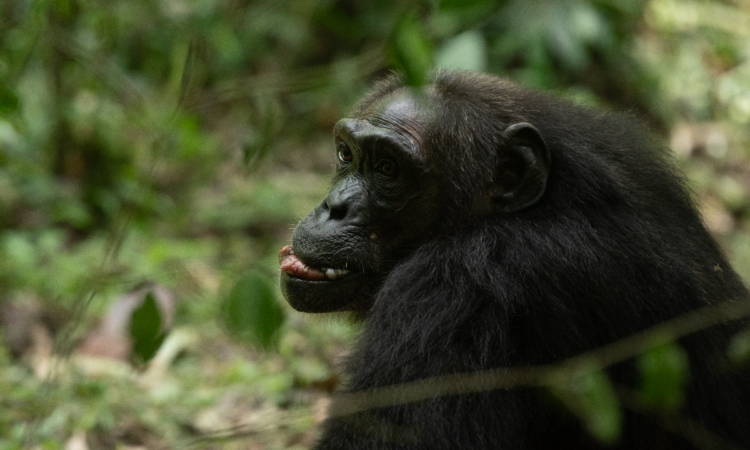
Extensive records of whether chimpanzees eat humans are extremely rare, therefore it is not a known fact that they do. However, scientific data shows that chimpanzees share around 98% of their DNA with humans, which makes us relatives. Like humans, however, chimpanzees are omnivorous, with their daily diet mostly composed of vegetables. In the forest, they usually forage for fruits, leaves, seeds, flowers and roots among others. Occasionally, they also forage for some insects, meat and eggs to supplement their diet.
Why a chimpanzee may attack a human?
A chimpanzee is most likely to attack a human being if there is a perceived threat from the latter. However, current records of chimpanzees aggressively attacking humans mostly happen on children. Such conflicts tend to happen in communities adjacent to chimpanzee natural habitats, where encroachment into these ecosystems has happened. During, periods of food scarcity in the forest, the hungry chimps will desperately move into people’s gardens to harvest their food. This increases contact with chimpanzees thus leading to aggressive conflict.
Also, tourists who confront chimpanzees in the forest might get aggressive responses from the primates. Though rare, the threatened chimpanzees may consider attacking the tourist as a survival strategy. Moreover, some tourists who carry food into the chimpanzee habitats might increase the chances of chimpanzees expressing aggressive behaviors towards them. Nevertheless, chimpanzee attacks can be limited by avoiding encroachment into chimpanzee habitats, and by tourists following chimpanzee trekking rules.
Best place to see chimpanzees?
Chimpanzee safaris are offered in many destinations in East Africa, however, Uganda and Rwanda offer some of the best. Uganda in particular offers chimpanzee trekking tours and chimpanzee habituation experiences in Kibale National Park. This is a pristine forested ecosystem found within the western region of Uganda, roughly 276 kilometers from Kampala by road. Among all destinations with chimpanzees, Kibale National Park is the perfect place to see chimps in the wild. Roughly 1,500 chimpanzees find shelter in this place. Just recently, the chimpanzees from the Ngogo community violently confronted each other.
However, there are other exciting options where chimpanzee tours are offered to cater for every person’s interest. For instance, you can trek chimpanzees in Kyambura Gorge and Kalinzu Forest in the southwestern part of Uganda. Budongo and Bugoma Forests are also fascination sites to see chimpanzees in the wild. These are situated in northwestern and western Uganda respectively. For visitors in Rwanda, chimpanzee trekking is mostly done in the pristine Nyungwe National Park in the southwest of the country. For visitors in Tanzania, trek chimpanzees in Gombe National Park, a destination renowned for hosting the legendary Dr. Jane Goodall.
Cost of seeing chimpanzees?
Chimpanzee trekking tours are offered at different prices depending on the destination you choose to visit. In Kibale National Park chimpanzee trekking tours cost US$250 for foreign nonresidents, US$200 for foreign residents and UGX180,000 for East African Community Citizens. Meanwhile if you choose to do chimpanzee habituation experiences, you are charged US$300 per person for foreign nonresidents. Foreign residents and East African Community citizens are charged US$250 and UGX250,000 respectively. Permits to do chimpanzee habituation in Kibale National Park will also change starting from January 1, 2027. Foreign non-residents will pay $400 per person, while the foreign residents will pay $300 per person. Citizens from the rest of Africa and East African Community will buy the permits at $250 and UGX250,000 per person respectively.
Other tariffs
Low season discounts on chimpanzee trekking have been introduced, making this activity available for only $200 per person for foreign nonresidents. Foreign residents in Uganda will now pay $150 per person to track chimpanzees during the low season. Tariffs for chimpanzee tours are expected to change in January 1, 2027. In Kibale National Park the price of chimpanzee trekking at $300 (foreign nonresidents), $200 (foreign residents), $100 (rest of Africa) and UGX180,000 (East Africa Community citizens).
Chimpanzee trekking costs the same amount of money in Kalinzu, Budongo and Bugoma Forests. Each person pays US$130 for Foreign nonresidents, US$65 for Foreign residents and US$65 for East African citizens. Chimp trekking in Kyambura Gorge costs US$100 for Foreign nonresidents, US$80 for Foreign residents and US$65 for East African citizens. Trekking chimps in Kyambura will also cost differently from January 1, 2027. It will be $200 (foreign nonresident), $150 (foreign resident), $100 (rest of Africa) and UGX50,000 (East African Community). Chimpanzee trekking in Nyungwe NP per person costs US$150 for foreign nonresidents, US$75 for foreign residents and US$25 for East African citizens.
Best time to see chimpanzees?
Dry seasons are the perfect periods to do chimpanzee tours across East Africa. During these periods, rainfall patterns tend to be predictable and or shorter if they occur. Such weather conditions cause the chimpanzee trails to be relatively drier than during the wet season. You will walk on less muddy trails thus avoid slipping on the ground. The vegetation cover is not so dense to make visibility difficult. Dry seasons during the year occur between June to August, as well as from December to February.
However, the wet season also presents favorable conditions to enhance chimpanzee tours in East Africa. Since there are many fruits for the chimpanzees in the forest due to heavy rains, you can locate them easier. Also, the dense vegetation that grows due to abundance of rainfall create beautiful backgrounds for photography. However, you should be cautious while walking on muddy slippery chimpanzee trails. Wet seasons mostly occur in the forests between March to May and October to November.


