
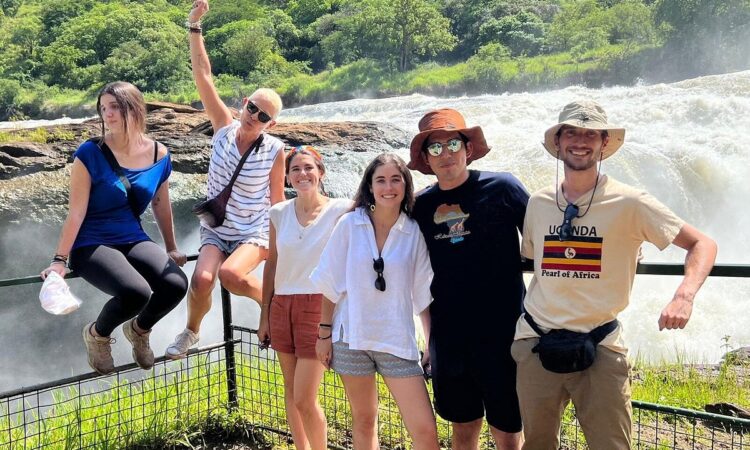
Join us for the best family safaris in Uganda, the ‘Pearl of Africa,’ a country that is deservedly celebrated for its unique biodiversity, cultural legacy, and natural wonders. Situated in East Africa and on geographical coordinates of latitudes 1oN and 4oS and longitudes 29oE and 35oE. Families are guaranteed the best safaris in Uganda since it is endowed with 10 national parks, 12 wildlife reserves, and 13 wildlife sanctuaries. Each of these offers unique activities and views that will make your family’s Uganda safari worthwhile. Activities that can be enjoyed in these picturesque safari destinations include game drives, birdwatching excursions, boat cruises, nature walks, forest walks, sightseeing, and plenty more.
Safari destinations suitable for your family
The key safari destinations that you and your family, including children, can explore in Uganda include,
Queen Elizabeth National Park
Queen Elizabeth National Park is the most popular in Uganda and covers a total land surface area of about 1,978 square kilometers in the western part of Uganda. Habitats within the park consist of savannah grassland, woodland, forest, wetlands, lakes, rivers, streams etc. Wildlife includes over 14,000 plant species, 600 bird species, and over 95 mammal species. The main activities that a family on a safari here can enjoy include the game drive, lion tracking, birding, boat cruise, and chimpanzee trek. The most exciting wild animals to see as a family are lions, leopards, elephants, buffaloes, hippos, crocodiles, chimps, warthogs, waterbucks Uganda kobs, etc. Birds here include the shoebill, grey crowned crane, pied kingfisher, and African fish eagle.
Murchison Falls National Park
Murchison Falls National Park occupies a remarkable 3,893 square kilometers in the northwest of Uganda and is named after the most powerful waterfall, Murchison Falls, along the Nile River. This savannah national park is composed of over 556 bird species and 144 mammal species that shelter and forage in the vast grassland and woodland. A family will find the following animals exciting to see: elephants, lions, leopards, buffaloes, waterbucks, giraffes, warthogs and hartebeests. Bird species a family will see include pied kingfish, Abyssinian ground hornbill, long-crested eagle, crested crane, and swamp warbler. Activities a family can enjoy include game drives, birding, boat cruises, and top-of-the-fall walks. The park is only 234 kilometers northwest of Kampala.
Lake Mburo National Park
Covering around 260 square kilometers, families on a safari here can enjoy a variety of tour activities in Uganda’s smallest savannah national park. You can choose from game drives, birding, boat cruises, biking, nature walks, horseback rides, etc. Lake Mburo National Park is composed of savannah woodland, grassland, lakes, swamps, rivers/streams, and other habitats. These contain biodiversity, such as over 332 bird species, 69 mammal species, and numerous butterflies, reptiles, and amphibians. A family will be amused by seeing animals like zebras, impalas, giraffes, elands, leopards, hippos, and buffaloes. The birds to enjoy include papyrus yellow warbler, Abyssinian ground hornbill, Ross’ turacos, shoebill, and African wattled lapwings.
Ngamba Island Chimpanzee Sanctuary
This is situated within Lake Victoria, Uganda’s largest lake in the central part of the country. A family will have an amazing time exploring this haven for over 50 chimpanzees that are cared for. Some of the chimpanzees are orphaned, while others were rescued from poachers and cannot be reintroduced into their natural habitat. While here with your family, there is a great opportunity to study chimpanzee behavior in captivity. This place also plays a huge role in educating visitors about chimp conservation. Other activities a family could enjoy while on a safari in Ngamba Island include fishing, a sunset cruise on Lake Victoria, a forest walk, a nature walk, and birdwatching.
Ziwa Rhino Sanctuary
This spans approximately 70 square kilometers in the central part of Uganda and was established to facilitate the re-introduction of rhinos that had become extinct in the country. A family with a kid from 6 years old and above on a safari in Ziwa Rhino Sanctuary has the best opportunity to see the white rhinos on a guided tracking tour. These rhinos are habituated and the sanctuary is the only destination where rhinos can be seen in the wild. However, while walking to locate the rhinos, other animals to encounter include hippos, antelopes, crocodiles, birds, and various species of reptiles. Bird species to encounter in the destination include the common bulbul, Abyssinian ground hornbill, grey crowned crane, and others.
Other safari sites in Uganda for your family to enjoy include the equator experience in Kayabwe, central Uganda. This offers families an opportunity to take pictures while standing between the northern and southern hemispheres. A family safari can also be done in Jinja to explore the Nile River where activities to enjoy also include boat cruises and quad biking. If you have children above the age of 15 years, you can enjoy a gorilla trekking tour in Bwindi Impenetrable National Park and chimpanzee trekking tours in Kibale National Park. The Uganda Wildlife Conservation Education Center is another exciting destination to take your family to explore Uganda’s wild animals in captivity. You can also go to the Igongo Cultural Center in Mbarara.
The best time to go for a family safari in Uganda
The dry months of the year are normally the best time to go for family safaris in Uganda’s tour destinations. The dry months are experienced during the months running from June to September and December to February. These periods are characterized by favorable warm and dry weather patterns, suitable for family safaris. The minimal amount of rainfall received during this time causes uninterrupted safaris, drier game tracks, less vegetation cover, and plenty of wild animals to be visible in the park.
What to pack for a family safari in Uganda
Enjoying your family safaris in Uganda is achieved if careful consideration is put into packing the following essential items.
- Wide-brimmed hat/cap
- Snack box and snacks
- Refillable water bottles
- Backpack
- Lightweight clothes
- Comfortable walking shoes with good traction
- UV-protection sunglasses and sunscreen
- Insect repellents
- Antimalarial drugs
- Basic first aid kit
- Warm sweaters
- Light rain jackets
- Camera and a pair of binoculars
- Travel documents


