
A brief history of Lake Mburo National Park
As you embark on a safari expedition in Lake Mburo National Park, it is best that you be guided on a lot of what this great protected area offers. Lake Mburo National Park’s existence dates back in the history of the mythical tales of the locals. It is believed that the land occupied by the park present date was a humble land of two brothers, Mburo and Kigarama. These people lived and carried out their daily duties of farming like any other ordinary local people.
One day, Kigarama had a dream of a great flood that was triggered by the heavy rains falling upon their land. As morning came, he told Mburo about the dream, but was quickly curbed down by Mburo saying it was just a dream, yet Kigarama believed it was more of a prophecy for what was to come. Kigarama later decided to take his property above ground to the neighboring hills. Not long after his departure, the dream came to pass as the area was hit by heavy rains that ended up flooding the entire land and drowning Mburo and his property. Thus, this area of the present-day park was named after Mburo, and the hills were named after Kigarama.
Lake Mburo National Park was established around 1933 during the colonial days as a controlled hunting ground. As it was later elevated to a game reserve status in 1963, the Banyankole-Bahima people dominated this area, grazing their cattle in the reserve. Fast forward to 1981, during the Obote II government, the game reserve was turned into a national park. This led to the expulsion of the Banyankole-Bahima pastoralists, with some of their property destroyed and cattle killed. Though it was believed that the government was deliberately publishing these people for supporting the NRA rebel group that was fighting the government.
Later in 1986, when the government of Obote II fell to the NRA, the pastoralists resettled in the parkland and killed most of the animals. This later prompted the government to gazette the land of the park.
About Lake Mburo National Park
Lake Mburo National Park, with just 260 square kilometers of land mass, is the smallest savannah national park in the country. It is located in Kiruhura district in Nyabushozi county, about 30 kilometers from Mbarara City. Lake Mburo National Park is arguably the closest protected area to the capital city, Kampala, as it is located just 240 kilometers west. What this park lacks in size, it makes up for in wildlife diversity, with over 69 mammal species scattered across its borders and over 332 bird species nesting in its different ecosystems.
However, Lake Mburo National Park’s diversity is not limited to the wildlife and birdlife species; it also hosts over 5 lakes. These lakes are a source of livelihood to the residents of this park but providing water. This area where the park is located is dominated by a semi-arid climate since it falls in the Ankole cattle corridor, though it receives a prolonged tropical weather of two dry and wet seasons annually. This weather is responsible for the growth of pasture and a constant source of all the lakes in the park, which keep the wildlife and birdlife going.
How to get to Lake Mburo National Park?
Lake Mburo National Park’s proximity to the capital makes its accessibility a piece of cake. The park is connected by a much-improved road network system. This makes all the travels to the park by road seamless and comfortable. In about 4 hours, visitors traveling by road from the capital can get to Lake Mburo National Park.
Travelers opting for a more luxurious travel can board chartered or scheduled domestic flights from Entebbe International Airport or Kajjansi Airstrip to Mbarara Airfield for just 1 and a half hours. Thereafter, connecting to the park by road for about 45 minutes. The park also has different gates, thus the time frame can change depending on which gate you use.
What to do in Lake Mburo National Park?
Lake Mburo National Park offers an undisputed set of tourist activities that are interesting to engage in. Some of these things to do in the park include the following.
- Game drives
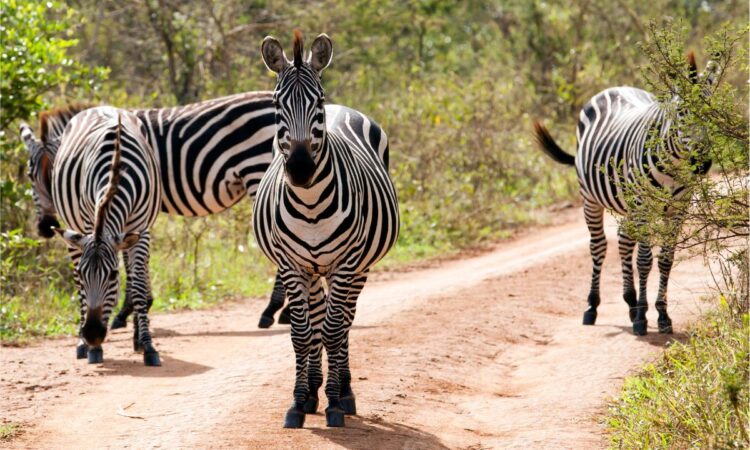
The wildlife diversity of Lake Mburo National Park keeps visitors entertained on a game drive experience as they get up close to the wildlife, all in the comfort and safety of the safari vehicle. Visitors have a chance to see a variety of wildlife species such as impalas, buffaloes, zebras, elands, topis, giraffes, warthogs, hyenas, and leopards, to mention but a few.
- Game walking safaris
Lake Mburo National Park is a perfect place for walking safaris, and this is attributed to the experience and professionally armed rangers who guide you through this experience as you encounter different wildlife species. This experience is incredible as it helps enjoy the wild and nature by being part of it. The walking safari in this park is also made possible since there are no lions in the park, which can pose a much bigger threat.
- Boat cruise
Boat cruise experiences take place on the largest lake in the park, Lake Mburo. This lake harbors a relatively larger number of aquatic wildlife species, especially the hippos and Nile crocodiles. During this boat cruise, visitors can also spot other wildlife species as they quench their thirst on the shores under the hot sun, such as the Cape buffaloes, impala, waterbucks, zebras, and topi, among others.
- Birding
The park is a natural paradise for nature lovers and birders since it hosts over 332 bird species that can be spotted during birding safaris. This birding experience is carried out with the help of an experienced professional birding guide with knowledge of most of the birds in the park. Some of the common birds to spot include the shoebill stock, African fish eagle, papyrus gonelek, white-winged warbler, African finfoot, Rufous bellied heron, black-bellied bustard, etc.


