
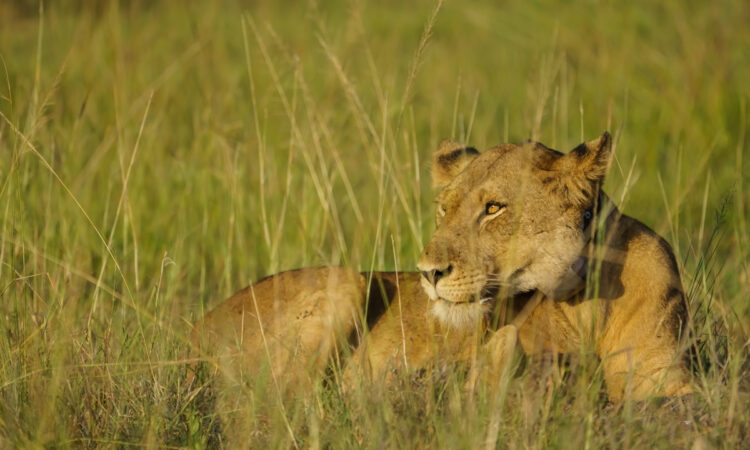
An increased price for experiential lion tracking in Queen Elizabeth National Park has led to $350 from $200. Each person has to pay this amount whether they are foreign nonresident, foreign resident or from the Rest of Africa. Anyone who is a citizen from countries within the East African Community pays 350,000 Uganda shillings. But, this increased price comes into effect on January 1, 2027. It is enough time for both visitors and tour operators to adjust bookings and travel budgets while avoiding disruptions to reservations.
Why the Increased Price for Experiential Lion Tracking in Queen Elizabeth National Park?
The increase is actually good news because the support for wildlife conservation will be enhanced through more revenues. We shall witness better facilities in Queen Elizabeth National Park as a result. Efforts to support community development initiatives are stepped up as well. Visitors should also expect guided experiences that are much more superior than the current one.
Meaning of Experiential Lion Tracking?
The experiential lion tracking is the visitor’s participation in locating, monitoring and study of lions in the wild. It involves accompanying conservationists and researchers in the natural habitats of the lions to see them up close. Compared to the ordinary game drive, this activity makes it easier to see the lions. This is because the lion is fitted with a radio collar. Equipment like telemetry receivers and directional antennas are used to pick up signals to locate the lion.
When to travel for Experiential Lion Tracking?
Make your choice to travel to Queen Elizabeth National Park on any day of the year. However, the weather conditions are not the same all year round. The park experiences either wet or dry season every year. If your travel in the dry season, you get the perfect weather, with warm and dry conditions. However, expect showers, because Queen is in a tropical region. A part from the atmosphere, the terrain is dry, offering the best conditions for driving. Vegetation cover is less dense, for you to get great views of lions. June to August and December to February are dry periods.
In the wet season, expect heavy rains, which might turn out to be frequent. This leads to muddy terrain in the park, thus affecting movement. Dense vegetation also offers too much cover for the lions to reduce visibility. Such circumstances offer thrills while you track the lions. Traveling in the wet season also presents the advantage of less crowds around you in the park. In comparison to the dry season, the people are significantly fewer to ensure that your encounter with the lions is quite intimate.
How to Travel to Queen Elizabeth National Park?
For an experiential lion tracking trip, travel to Queen Elizabeth National Park in either a vehicle or air craft. On the road to Queen Elizabeth National Park from Kampala, cover a distance of 402 kilometers. For 7-8 hours, the vehicle passes through Masaka, Lyantonde, Mbarara, and Bushenyi. A flight to the park lands in Kasese airstrip. From Entebbe International Airport, your flight takes only 1 hour and 15 minutes to arrive at the airstrip. From there, use ground transportation to reach Queen, in a drive that takes half an hour.
About Queen Elizabeth National Park
Queen Elizabeth National Park offers rich history and current aspects that make it an interesting destination. With a size of 1,978 square kilometers, this is among Uganda’s largest national parks. Queen is also among the oldest in the country as it was established as a national park in 1925. At that time, it was Kazinga National Park, and 2 years later, the name was changed to Queen Elizabeth National Park. This was done to celebrate the visit by Queen Elizabeth II.
Visitors to Queen Elizabeth National Park get excited to see any of the 95 mammal species and 600 bird species. With 4 of the Big Five, Queen Elizabeth National Park has proved to attract thousands of visitors to see them. Only the rhinos, do not live there, but buffaloes, lions, leopards and elephants live there. The savannah also shelters warthogs, hippos, antelopes and others. Bird species to find in Queen Elizabeth National Park include long crested eagle, laughing dove, pied cuckoo and common swift.
A great deal of unique natural features exists in Queen Elizabeth National Park. There is the Equators crosses the park, with a monument already built at the imaginary line. The Katwe Explosion Craters, Lake George, Lake Edward, forest, swamps, grassland, Kazinga Channel, woodland and forest are found in Queen. Meanwhile, from the park, vistas of the beautiful Rwenzori Mountains can be got.


