
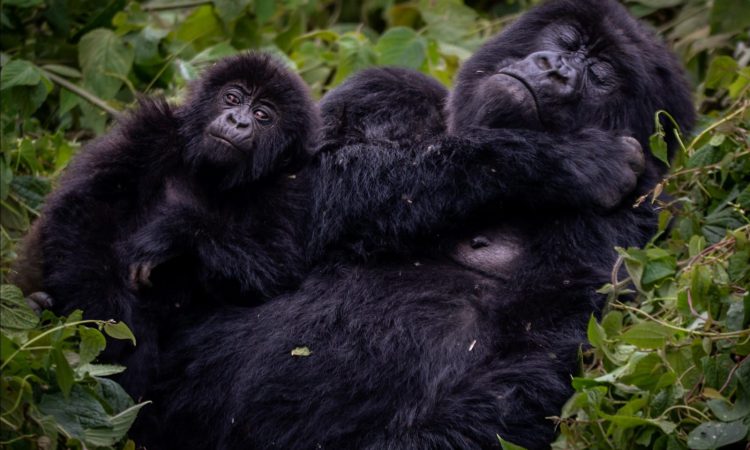
Mukiza Gorilla Family in Ruhija sector is a habituated group that stays in Bwindi Impenetrable National Park. The Mukiza family enjoys moving inside the forest and is rarely seen around the boundaries of the forest. Silverback Mukiza leads the family. He was born on 29th November 1990, by Mugwere. As you have already figured out, the family was named after him.
Members of the family
The family is made of 19 members with one of the latest babies born in 2020 by Mwijuke. This family is comprised of 1 silverback, 8 adult females, 1 subadult female, 2 juveniles & 7 infants. Some of the members include adult females like Twijukye, Mugenyi, Mugwere, Bwebisha, and Korugyezi, sub-adult males like Kanywanyi, juveniles like Tonvi and knowledge not forgetting the babies of the family like Nyakabara and Gorodi.
Family history
Long before Mukiza came into existence in May 2016, the gorillas in this family used to stay together with the members of Kyaguriro. Rukara evaded the groups and in the quest for struggling for power, Mukiza chose to walk away with some ten members. He was able to create his own family which is why it is sometimes referred to as Kyaguriro B. Another theory about the creation of Mukiza is that Mukiza a young silverback lost control of a large gorilla group hence walking away with a few manageable members to start a new controllable family.
The uniqueness of the family
It increased the number of gorilla trekking families from 3 three to four. This means that the number of gorilla trekking permits also had a rise from 24 to 32.
It enjoys the inner areas of the forest, especially in the Ruhija sector. Therefore, tourists who love nature should embark on exploring this gorilla family.
The family is made of more females than men hence individuals who wish to spot on the behavior of women gorillas shouldn’t miss this family.
The beauty of trekking the family
Trekking Mukiza is a blessing in disguise for those lucky enough to. Explore the park and enjoy the beauty of the forest as the family enjoys spending most of its time in the depth of the forest.
Tourists in love with gorilla habituation experience have a family to enjoy the activity. This is because the family is under research by the Manx Prac Institution for Evolutionary Anthropology.


