
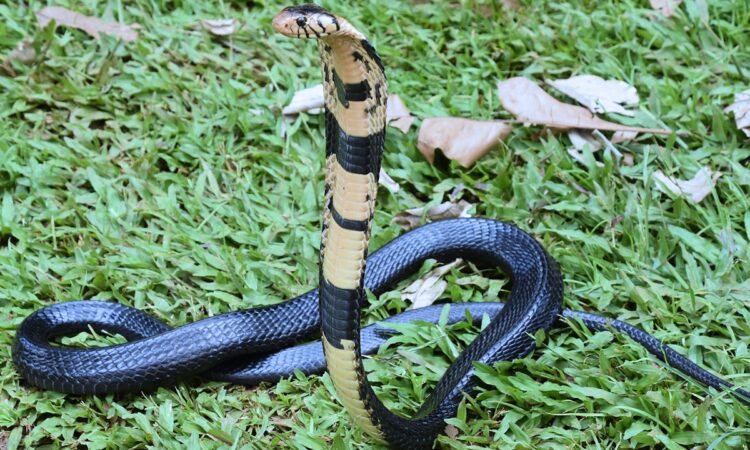
Bwindi Impenetrable National Park is primarily a primate destination famous across the world for being the best gorilla trekking destination. However, Bwindi Impenetrable National Park not only hosts the endangered mountain gorilla primates but also other species and notably the snakes. Bwindi Impenetrable National Park, being a vast, dense tropical rainforest, is suited for hosting snakes. This is because the environment in Bwindi is perfect for snakes to thrive. The park has favorable conditions for the snakes from the shelter, to food inform of prey, and water. The snakes in Bwindi Impenetrable National Park increases in number every year due to their safety from human conflict deep in the forest.
Snakes are unfortunately seen as a threat by many, but this should not be the case, as these creatures have done tremendous work to stabilize the food ecosystem. This is done through hunting and feeding on the pets and insects that would spread diseases and destroy the gardens of the neighboring communities. However, the snakes do not just stop at this but rather go forward and help in soil aeration by making holes in the soil, thus keeping the soil moist and aerated. Understandably, there could be cases of fear for these snakes, but it is important to note that these reptiles usually avoid human contact and flee in case they sense them.
Bwindi Impenetrable National Park’s snake population is most concentrated along the swamps, and the dense forest canopies. The four sectors of the park, i.e., Rushaga, Buhoma, Ruhija, and Nkuringo, on top host the mountain gorillas but also house these snakes. However, snakes are much harder to spot given their shy nature and solitary life under the dense canopies. There are over 14 species of snakes in Bwindi Impenetrable National Park on record, with about 9 species endemic to the forest. These reptiles have grown to be part of the ecology and biodiversity of Bwindi. The snakes in this park are of two types: venomous and non-venomous snakes.
Venomous snakes are sometimes called poisonous and are snakes that possess a lethal venom or poison. They use this venom when hunting down their small prey by striking them with precision and injecting enough venom to kill them. Some snakes possess venom that causes a blood clot in the heart of the victim. However, these venomous snakes also use this venom as protection when they feel threatened. Examples of Venomous snakes include black mamba, forest cobra, African tree cobra, great lakes bush viper, and puff adder, among others. Non-venomous snakes are also present in Bwindi Impenetrable National Park. These snakes rely on stealth and strength to hunt down prey and also speed to flee if threatened. Non-venomous snakes in Bwindi Impenetrable National Park include the African rock python and Gunther’s green tree snake.
What else to see and do in Bwindi Impenetrable National Park?
Bwindi Impenetrable National Park is packed with a variety of things to see and do, as shown in the following.
Gorilla trekking
When talking about Bwindi Impenetrable National Park, then gorilla trekking takes central stage as the major tourist activity in the park. Bwindi Impenetrable National Park hosts over half of the entire population of mountain gorillas, totalling up to 459 individuals. Gorilla trekking is the process of encountering these primates in their natural surroundings for an hour. Mountain gorillas are social beings, meaning they stay in groups, and trekking exposes their lifestyle of feeding, resting, playing, and grooming the infants before your eyes. Trekking mountain gorillas happens immediately after a pre-trekking briefing, which highlights the dos and don’ts of this activity to the visitors.
Birding
The mass wilderness of Bwindi Impenetrable National Park is dominated by mixed tropical vegetation of rainforests and dense undergrowth, and over 350 bird species nest here. A birding experience takes visitors on a thrilling adventure to discover these birds in their natural habitats. The park has several birding trails that are well designated, leading straight to the habitats of these birds. Bwindi hosts two forms of bird species, the endemic birds, which are the residents and common to the forest, and the migratory birds, which show up in specific seasons. Some of the birds to spot on a birding experience in Bwindi include grey-throated barbet, red-tailed greenbul, black bee-eater, white-tailed ant thrush, white-bellied robin-chat, great blue turaco, and black billed turaco, to mention but a few.
Nature walks
Bwindi Impenetrable National Park is the perfect place for nature lovers and adventure seekers, as its nature walks bring out adventures never seen anywhere else. The vast landscape, overflowing with dense forest and overgrown canopies, holds incredible scenic views placed along the walking trails. The common trails used for nature walks or hikes in Bwindi include Ivi River Trail, Buhoma-Nkuringo Trail, and Muyanga Waterfall Trail, etc.
Batwa community
Termed as the forest keepers, the Batwa people of Bwindi Impenetrable National Park are some of the oldest groups of people in Africa. Their fame dates back generations before the establishment of Bwindi as a national park. They dwelled in this park for many years, and as civilization and conservation of mountain gorillas came into play, they were forced out to the communities. Visitors can visit these people in their new communities and learn about their history, way of life, and the skills they used to survive in the forest for a while.


