
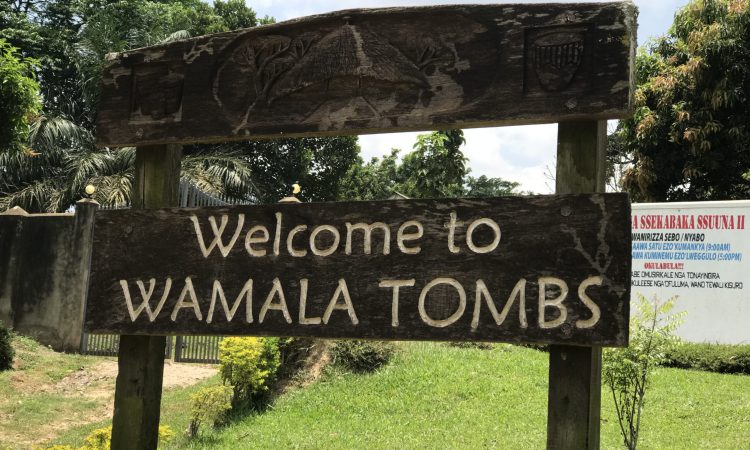
Wamala Tombs – Visit the Resting place of Kabaka (King) Ssuna II on a Uganda Cultural Tour

The Wamala tombs are the resting place of Kabaka Ssuna II and they exist in the present Kampala – the capital of Uganda. Located in the Nabweru sub-county Nansana Municipality along Wamala road, Wamala Tombs are one of the best places to visit on a Uganda cultural tour. For those taking on a Kampala city tour, Wamala Tombs should not be missed on your travel list since there is a lot to learn during your Uganda Safari.
King Ssuna II ruled Buganda Kingdom from 1836 to 1856 and his leadership has lived to be a story worth telling to the generations to come. The standout point about the leadership of Kabaka Ssuna is that he is among the few African leaders who first welcomed foreigners. He is the king who welcomed traders, especially Arabs to Uganda and the Buganda kingdom in Particular. King Ssuna was also among the leaders who ruled Buganda with an iron hand and had little room for nonsense in his regime.
Where are Wamala Tombs located?
The Wamala Tombs are located in Uganda – Kampala city – Nansana Municipality – Nabweru sub-county between Kawanda market. The tombs are located near Entebbe Express Highway (and the Northern Bypass). From Entebbe International Airport, one can drive for about 20 minutes before they reach Wamala Tombs.
The Story Behind the Name Wamala Tombs
Like many other historical sites in Uganda, there is a story behind the name Wamala Tombs. It is said that while Ssekabaka Ssuna was leaving his initial palace in Mulago (a suburb in Kampala central), he embarked on a search for a new palace to settle. He landed on this strategically located hill, he loved the views and the area in general and commanded his kinsmen to stop. In saying this, he remarked that “Wano Wamala” which translates to “Here is enough or Let’s stop here.”
From then, the place was named Wamala and the king constructed his palace in the very area which happens to be his resting place.
Geographically, the Wamala Hill (where Wamala Tombs are located) is strategically located to view most of the hills in Kampala. Strategic views were paramount in choosing the right spot to set up a palace for kings in Uganda and Africa as a whole. This was meant to see the enemy from a distance in case there was going to be an attack. The royal guards would launch an attack fast and defeat the enemy hence protecting the king.
At the hill, there are small rocks that are shiny just like stars in the moonlight. The small rocks are locally known as “Emunyenye” This is why the place was named Wamunyenye. The King had her mother in the neighboring area – Kagoma (a small drum). In the early years, the drums were used to communicate. Whenever the king’s mother wanted to communicate with her son, she would hit the drum. Immediately, the king would send a servant to her mother in response, and communication between the two was effected. Thus the place was named Kagoma as a result of the continuous communication (drumming) by the king’s mother.
Why you should visit the Wamala Tombs? What to see and do at Wamala Tombs?
The Wamala Tombs are worth your attention while you take on a Uganda tour or Kampala city tour. You may as well visit the place in case you have limited time on your calendar. The Wamala Tombs play a significant role in the history and traditions of the Buganda kingdom and Uganda as a whole. It is one of the few remaining sites in Uganda where one can be able to learn about ancient leadership and power struggles in Africa.
At the Wamala Tombs, you will learn about the coming of Arabs in Uganda. You will also learn about the coming of Islam in Uganda. This marked the beginning of industrialization in Uganda since most of the Arabs were major traders. Up to now, the area is dominated by Muslims.
Additionally, you will learn about the social life of Buganda kings like the number of wives each king is supposed to marry. At Wamala Tombs, you will visit the graves of all the wives of King Ssuna II. You will get a chance to interact with his present wife since the Baganda do not believe that their kings die but rather disappear. Once the king disappears, it is mandatory to keep giving him wives from different clans in Buganda.
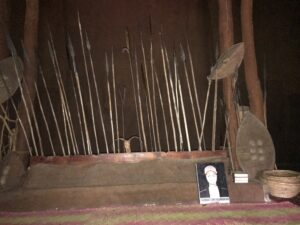
You will also see the items and tools that the king used to hold while hunting or fighting. Some of these tools include; spears, shields, head gears, backcloths, shoes, and many more. One of the items to see at Wamala Tombs is the Quran (Muslims’ Holy Book) which was gifted to the king by the first Arabs and Muslims to step into Buganda.
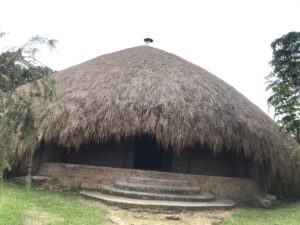
The shrine is built with traditional building materials like grass and reeds. It is thatched with some building materials some of which are symbols of Buganda’s cultural heritage. You will see the reeds representing all the clans in the Buganda kingdom while you visit the shrine at Wamala Tombs.
Which other places can I visit while touring Wamala Tombs?
A tour of Wamala Tombs can be combined with other places like Kasubi Tombs, Bahai Temple, Mengo King’s Palace, Kabaka’s Lake, Uganda Museum, Uganda Equator, Gadhafi Mosque, and many more.
How much is a tour of Wamala Tombs? Wamala Tombs entrance fees.
Wamala Tombs visit requires one to pay entrance fees which are approximately 10 USD for foreigners, about 10,000 Uganda Shillings for Ugandans, and 5,000 Uganda Shillings for students. This price is exclusive of other expenses like food, transport, and accommodation. Book through an authentic tour operator for an all-inclusive quotation.
What is the best time to visit Wamala Tombs?
Wamala Tombs is open to tourists all year round. It is advisable to book a tour to Wamala tombs with Standard Safaris, a reputable local tour operator for ultimate experience and we also organize tours to other destinations around Uganda. Book your Kampala city tour now and create a signature of memories while you visit places like Wamala Tombs.


