
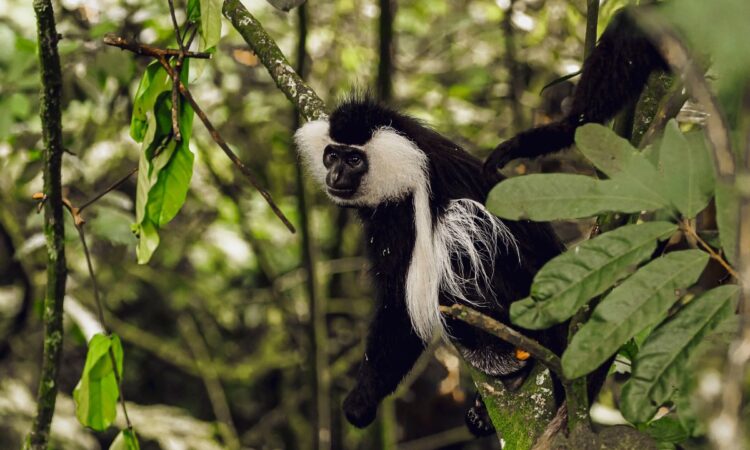
Bwindi National Park is not only home to around 459 mountain gorillas but also houses hundreds of other animal species. For example, there are at least 135 mammal species that have been recorded in Bwindi National Park. This makes Bwindi National Park not only a prime destination for gorilla tours, but also a place to spot plenty of other animal species in their natural habitat.
Mammal species include the African elephant, African wild cat, African white-bellied pangolin, honey badger, red-flanked duiker, Weyn’s duiker, yellow-backed duiker, black-fronted duiker, grey bushbaby, African golden cat, Carruther’s mountain squirrel, sitatunga, bushpig, Servaline genet, African civet, African palm civet, bushbuck, African bush-tailed porcupine, marsh mongoose and side-stripped jackal to mention but a few.
There are at least 11 primate species that call Bwindi National Park home. Some of the primates are threatened species and need to be conserved to avoid extinction. The primate species residing in the Bwindi National Park besides the mountain gorilla include L’hoest’s monkey, spectacled galago, Prince Demidoff’s galago, De Brazza’s monkey, common chimpanzee, black-and-white colobus monkey, blue monkey, red-tailed monkey, potto and olive baboon.
Bwindi National Park is an Important Bird Area (IBA), with 357 bird species residing here. Among these bird species, there are at least 23 Albertine endemic species recorded so far. The birds residing here include the African green broadbill, Chapin’s flycatcher, Shelley’s crimson-wing, Grauer’s swamp warbler, crested guinea fowl, scaly francolin, Lagden’s bush shrike, forest ground thrush, Turner’s eremomela, handsome francolin and dwarf honey guide etc.
Facts about Bwindi National Park?
Bwindi National Park is a UNESCO World Heritage site situated in southwest Uganda, on the edge of the Albertine Rift Valley. Bwindi National Park was established in 1991 and now occupies a total land area of around 321km2. Bwindi National Park sits on altitudes, ranging from 1160 to 2607m above sea level. Bwindi National Park lies on geographical coordinates approximately 0o53’ — 1o08’N and 29o35’ — 29o50E.
Bwindi Impenetrable National Park is a natural forest whose landscape is characterized by rugged terrain and lush vegetation. Bwindi National Park is also blessed with narrow valleys and steep ridges. The vegetation is greatly varied and classified as medium-altitude moist evergreen forest and high-altitude submontane forest. Undergrowth is also a significant part of the vegetation, and the dominated by thick herbs, shrubs and climbers/lianas among others.
There are 4 sectors in Bwindi National Park, which are Rushaga, Nkuringo, Buhoma, and Ruhija. In these gorilla sectors, there are at least 23 gorilla families habituated for gorilla trekking tours. Each sector offers unique but worthwhile trekking experiences. Depending on your interest, you may either choose a more challenging trekking experience or the opposite. Ensure to communicate with a trusted tour operator like Standard Safaris for the perfect sector to trek in.
Activities in Bwindi National Park?
Bwindi Impenetrable National Park is a popular destination for gorilla trekking. This is a great chance of tracking a habituated gorilla family. An hour is offered to spend in the presence of the mountain gorillas once encountered. Take photos and watch their delightful interactions. For an extended time with a gorilla family, a gorilla habituation experience is offered in Rushaga sector. This offers 4 or more hours in the presence of a semi habituated gorilla family.
Other activities to enjoy in Bwindi Impenetrable National Park include nature walks, Batwathe trail, birdwatching, photography, and community tours, etc. Bwindi offers several important trails to follow while birdwatching, nature walking, seeing streams, waterfalls, and swamps, etc.
What is the best time to see animal species in Bwindi National Park?
The animals in Bwindi National Park can be seen throughout the year. But, an outdoor activity in a forested ecosystem like Bwindi is best done during the dry season. This means that you should travel in January, February, June, July, August, and December. The weather conditions during the dry season offer easier movement in the forest. This is because the forest trails are drier and the vegetation cover is also less dense. Viewing is also much better.
How to travel to Bwindi National Park?
Traveling to Bwindi National Park is possible exclusively by road and air transport. A scenic road trip from Kampala to Bwindi National Park covers a journey ranging from 480 to 530 km depending on which sector you are going to. You can reach Bwindi National Park by road from other destinations like Kibale, Queen Elizabeth, Murchison Falls, Lake Mburo, and Rwenzori Mountain National Parks. You can also get to the park by road from Kigali and Volcanoes National Park.
Since Bwindi National Park has a rugged terrain, you may consider travelling by private transportation. At Standard Safaris we have a range of tourism vehicles including the 4×4 safari land cruiser that suits this sort of trip. But, if you find the 9–10-hour road trip too taxing, we recommend the time-efficient and more convenient air transport. This takes between 1 hour and 15 minutes to around 2 hours to either Kihihi or Kisoro airstrips.
This is a scheduled flight that starts at Entebbe International Airport and is operated by the always reliable AeroLink. Standard Safaris is still your most trusted tour operator to secure the flight for you. In this case, inconveniences will be avoided to ensure a smooth transfer to Bwindi National Park. From either airstrip the remainder of the journey to Bwindi National Park is by road. With our professional driver guides, we can do this very efficiently.


