
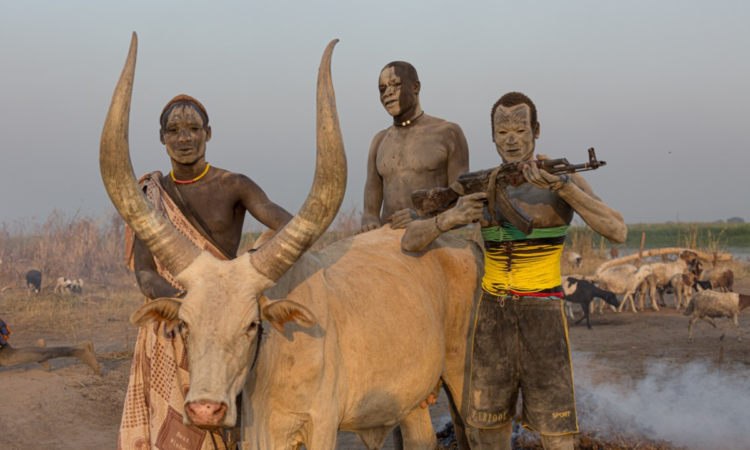
Tribes of South Sudan amount to 64, which have so far been recognized in the 644,329 square kilometer country. Some of them are described as below.
Mundari
The Mundari also known as Mandari are a small tribe found in the Central Equatoria State of South Sudan. Their population is almost 100,000 people, living in Tijor, Tali, Muni, Tombek, Mangalla, Gemeiza, Tindilo, Tali, Rego, Terekeka and Nyori. Mundaris are part of the Karo people encompassing tribes like Bari, Kakwa, Pojulu, Nyangwara and Kuku. They speak Kutuk na Mundari, which has similarities to the Kutuk na Kakwa, Kutuk na Kuku and Kutuk na Nyangwara etc. Dialect of the Mundari tribe is similar to the Bari tribe.
The Mundari people occupy flatlands with inselbergs, and also near lakes and rivers. Neighboring tribes of the Mundari include the Nyangawara to their southwest while the Bari live to their south and southeast. They are organized in agnatic exogamous societies. Cattle keeping is the key occupation among the Mundari and a large cattle herd is a sign of immense wealth. These livestock are a form of currency used in marriage, with the man’s side offering to the female’s as bride price.
To gain as much cattle as possible, the Mundari usually engage in cattle rustling wars, especially with the Bor Dinka. Cows are also a source of milk, blood and urine for dying and beautifying their hair. They also cultivate crops such as sorghum, while fishing is another source of livelihood. Scarification is practiced as a rite for men to pass into adulthood. This is done on their foreheads. They also do cattle camps, like the Dinka.
Dinka
The Dinka tribe also known as Jieng live in the lakes and Jonglei states of South Sudan. This Nilotic tribe can be found along the White Nile in the Bahr el Ghazal region. Dinkas are the most populous people in South Sudan, with 4.5 million people. Like the Mundari tribe, the Dinka are also pastoralists who view cattle as a source of wealth. They hardly eat or sale their cattle, though rely on them for milk, blood, rituals and marriages. Crop farming, growing sorghum, millet, groundnuts, sesame and Gum-Arabic are also done among the Dinka.
On average the Dinka are the tallest people in Africa, with mean height of 176.4 centimeters. They speak Dinka and are organized in clans with no central authority besides chiefs. Scarification among the Dinka is also done for initiation into adulthood or age group. Some women of particular status are scarified in their faces. Also the Dinka people remove the 4 lower canines of their teeth to indicate maturity. Cattle camps are hugely part of Dinka culture. Dinkas also believe in the afterlife, respecting the spirits of the dead and God.
Lotuko
Also known as Othuo. The Lotuko tribe is primarily found in the Eastern Equatoria State of South Sudan. The Lotuko people have decently large population numbering up to 70,000 people. Occupying mountainous areas adjoining plains, these people speak a language suitably called Otuho. Here they are able to practice agro-pastoralism. Besides cattle, they also rare large numbers of goats and sheep. Crops grown in their lands include maize, sweet potatoes, sorghum, tobacco, ground nuts and sesame.
Their neighboring tribes are quite many including the Lokoya and Lulobo to their northwest and Acholi to their south. To their north, the Lotuko are bordered by the Lopit and Pari while the Dongotona and Logir are to their southwest. The Boya and Didinga live to their east. Visitors hoping to meet the Lotuko should visit them in the villages of Hidonge, Chalamini, Illoli, Offi, Imurok, Obira, and Burung. You can also find the Lotuko in Tirangore, Haforiere, Langairo and Abalua. Lotuko tribe offers distinct cultural practices for example exogamy.
Lopit
The tribe of Lopit or Lopet are found in the Eastern Equatoria State of South Sudan with a population of 30,000 people. Lopit people prefer calling themselves Donge, who occupy the Lopit area in the Lopit mountains. This area is bordered by the Otuho and Lokoya to the west and to the east by the Toposa and Boya. To the south they are bordered by the Dongotono and the Bari, the latter of which are to their northwest. Bordering them to the north are the Tennet while the Pari live to their north.
The Lopit practice agro-pastoralism, keeping cattle and other livestock. Key crops grown by the Lopit include simsim, sorghum, groundnuts, millet, pumpkin, tobacco and bulrush. Visits to meet and interact with the Lopit can be done in Lohotok, Hiyala and Mehejek. You will learn a lot about the Lopit cultures, language and various aspects about their lives. For instance, they speak a language similar to the Maasai, Dongotono and Lotuka. Also take time to notice how they practice initiation rites in childhood, adulthood and age-set among others.
Toposa
The Toposa or Taposa tribe live in the greater Kapoeta region of the Eastern Equatoria State, South Sudan. Their lands are largely arid, while they occupy hilly areas and ridges. In South Sudan the population of the Toposa stands at 750,000, who mainly speak Toposa language. To distinguish them from other tribes in South Sudan, the Toposa practice ethnoreligion. They share some aspects with some tribes including cattle raiding and warfare. Pastoralism is a key occupation among the Toposa with their cattle herds also containing donkeys, camels, goats and sheep.
The Toposa also pan gold and other precious minerals found beneath their soils. They speak Toposa, a Nilotic language also known as Taposa or Topotha, which is very similar to Turkana. They have some tribes living as their neighbors, such as the Jie, Murle and Kachipo to their north. Didinga, Boya and Pari live to their west and southwest, while the Nyangatom to their east. Meanwhile, the Turkana border them to the south. Villages where the Toposa have settled are Riwoto, Mogos, Lamurnyang, Narus, Kapoeta, Naita and Karukomuge.
Larim/Buya
The Larim or Narim are a Surmic ethnic group with almost 25,000 people in Eastern Equatoria State, bordering Kidepo Game Reserve. They are largely found in the Budi County, which is part of the greater Kopoeta region of South Sudan. Larims mostly occupy areas in the south and west Boya Hills. These are situated in the areas around the Mountains Kosodek and Lobuli. Their dialect is related to the Dongotona, Murle and Tennet. Occupation of the Larim is mostly agro-pastoralism. They also engage in fishing and hunting game.
Socially the Larim are organized in agnatic exogamic lineages with hereditary chiefs. However, they share the same rain-chief with the Didinga tribe. The Larim also believe in the afterlife, with spirits of the deceased still living around them. Cattle is a medium of exchange among the Larim. These people also practice scarification as initiation into adulthood. Though the Larim are highly religious, they do not have a specific religion. They instead believe in a supreme being just like many tribes.
Jie
The Jie or Jiye is a tribe living in Pibor and the Eastern Equatoria State of South Sudan, near the Uganda border. They live in the areas around the Kathangor hills found within the border between the Upper Nile and Equatoria. Jie are closely related to the Karamojong, Toposa and Turkana. Jies are pastoralists whose men leave home with the cattle during certain seasons to search for good pasture. Meanwhile their females and kids stay in permanent homes, with the former growing crops on small plots. Crops grown include millet, maize, cow peas and tobacco.
The language spoken by the Jie is much like that of the Toposa, implying that they diverged due to some conflicts. Their similarity to the Toposa tribe is evident in a variety of practices including marriage, burial and death ceremonies. Also, they celebrate warfare, hunting and cattle raids. Plus, Jie have distinct art, music and dance that reflect their history, mostly similar to the Toposa. Neighbors of the Jie include the Kachipo and Murle to the east and north, while the Toposa to their south.
Lokoya
The name Lokoya is a distortion of Akokoya, which was given to them by the Bari tribe, thanks to their cattle rustling lifestyle. Their current population is 30,000 and occupy hilly areas and valleys situated east of Juba city. Lokoya are largely agro-pastoralists, who love keeping cattle, sheep and goats. Subsistence farming is prevalent with crops such as simsim, sorghum, maize and ground nuts grown. Hunting is one of the key economic activities of the Lokoya, mostly done in the dry seasons.
The Lokoya possess distinct cultural traditions expressed in their practices surrounding death, burial, naming ceremonies and marriages. You will notice that their dialect is quite similar to the Lotuka or the other Ohoryok groups. A variety of tribes neighbor the Lokoya. To the north, there is the Pari, while to the south they have the Acholi. They have the Lotuka and Lopit to their east while the Bari and Luluba are situated to their west. To meet the Lokoya with us, you must visit the towns of Ngangala and Liria in the Eastern Equatoria State.
Didinga
The Didinga are found in the Eastern Equatoria State of South Sudan, bordering Kidepo National Park in Uganda. There are 60,000 people belonging to the Didinga tribe who occupy the valleys, plateau, plains and slopes of the Didinga hills. Though the Didinga people are largely cattle keepers, they also do crop farming on a small scale. Crops such as tobacco, beans, wheat, maize, sorghum and pumpkin thrive on their lands. To the Didinga, cattle is a sign of wealth, as well as used to offer them milk and blood for consumption.
The language the Didinga speak is Didinga-Murle, which is also shared by the Boya, Tennet, Mursi and Murle. A number of tribes neighbor the Didinga, including the Ketebo, Toposa, Logir, Boya and Dogotona. To meet the Didinga you must visit Budi County. Like all tribes in South Sudan, the Didinga have different clans, cultures and traditions. These are expressed in marriage ceremonies, child naming ceremonies, death and burial etc. For example, if a female is sterile, the husband cannot divorce her, making this practice rare.
Dongotona
Dongotona are also known as Dongotono, who live in the Eastern Equatoria State along the Lomokidang Mountain. There are 20,000 Dongotona who live on the northwestern slopes of the Dongotono Massif. The Dongotona are closely related to the Logir and Lango people who speak Lotuka, just like them. Their livelihoods are derived from agro-pastoralism, rearing herds of cattle, sheep and goats. They also engage in subsistence agriculture growing crops such as simsim, sweet potatoes, groundnuts, and sorghum etc.
The Dongotona also coexist with a variety of neighboring tribes. Lotuka tribe are situated to the north, Langos to the south, Logir to the east and Imatong to the west. They share similar cultural beliefs and practices with the Lotuka. For example, the Dongotona believe in spirits, which eventually transforms into a clan’s animal when the body dies. Their unique practices are also expressed in burial and marriage ceremonies. Visitors intending to see these beautiful people should go to the towns of Isoke, Ikotos and Isoke Mission.


