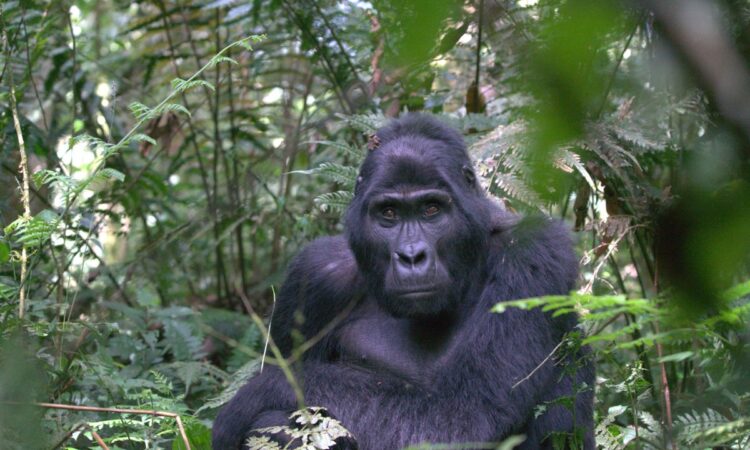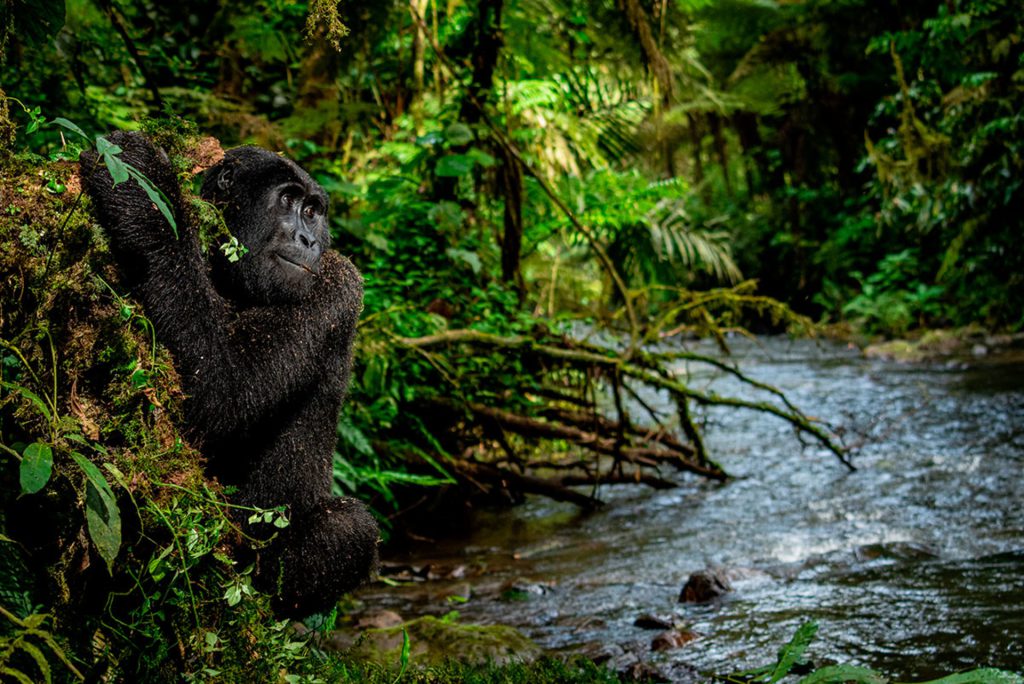
Can gorillas swim? Similar to other apes and a few humans, gorillas cannot swim. This makes them try to avoid large quantities of water like lakes. They have a large body structure which really makes it difficult for them to swim.
Gorillas are not known to be strong swimmers and are known to avoid water whenever possible. Gorillas do not have a natural inclination to swim because their body structure is a stocky body with shorter limbs which is not well suited for efficient swimming.
However, gorillas can swim through shallow waters if necessary, crossing small streams or rivers. In such instances, they typically use a combination of walking alongside the riverbeds if they are unable to touch the bottom.
Gorilla Behaviors.
A gorilla is a large, powerful, and intelligent primate known for its close genetic relationship to humans, sharing almost 90% of their DNA.
Gorilla behaviors are complex and fascinating, which displays their intelligence.
Gorillas live in groups called troops or bands, led by a male silverback who is the largest and strongest among others. These troops vary in size and consist of different members, like females, juveniles, and infants.
Gorillas have a unique and rare mode of communication through which they express their emotions. These include body language and facial expressions such as chest beating, grunting, and roaring.
These channels are signs of danger, maintain social bonds, and establish dominance.
The male-dominant silverback is responsible for protecting the members of the family group against any threats as well as keeping and maintaining peace and order.
They are herbivorous, feeding on stems, leaves, fruits, and shoots. They spend the whole day feeding on these items.
Gorillas engage in and participate in different social plays and interactions, which help build strong bonds and develop different skills among themselves. They participate by playing, chasing, and mocking battles.
During the day, they build new nests to sleep in during day rests and night rests. These nests are built using leaves and tree branches on a daily basis.
Gorillas have been found to confront each other on matters concerning family group inheritance.
They use tools like sticks or tree branches to help them forage as part of their daily routine.
Gorilla behavior is marked by complex and social dynamics to build strong family bonds and adaptability to their forested habitats. When you get to understand their behaviors, you can easily interact with them in their natural habitats.
Gorilla lifestyle.
Gorillas are active during the day as they feed, rest and socially interact with other members.
Gorillas stay in nests which are built every single evening.
Gorilla threats are poaching, habitat loss due to deforestation and attack of diseases and pandemics like Ebola.
Gorillas are found of staying in groups comprised of a number of members like females, juveniles and infants all headed by a silverback whose role is to protect its members against any threat.
Where do gorillas stay?
Gorillas are divided into different subspecies and each of these has different habitats.
Eastern gorillas stay in montane forests in the volcanic mountains found in East Africa. Such destinations are the Virunga Mountains bordering Rwanda, Uganda, and Congo and Bwindi impenetrable national park in Uganda.
Eastern lowland gorillas live in the lowland montane forests of eastern Congo.
Western lowland gorillas live in swamps, dense forests, and lowland rainforests in central and west Africa. Such destinations include Congo, Cameroon, Nigeria, and Angola.
Cross river gorillas, also known as western gorillas can be found in countries like Nigeria, Cameroon, and the cross-river region.
Why meet Gorillas with us?
Everyone who has visited Uganda, Rwanda or DRC for gorilla trekking with us never stops praising our services. You can actually read their genuine responses and 5-star reviews on TripAdvisor. Uganda is where we are based and registered by Uganda Tourism Board. But, we also operate in Rwanda as well as DRC due to strong relations with the tour destination authorities and accommodations. This is so convenient when it comes to gorilla permit acquisition, accommodation, transportation etc. You should contact us if you need to plan a visit to see gorillas in any of the mentioned 3 countries. It is also possible with us to include a gorilla trek in a comprehensive itinerary.